Can You Get Paid to Sleep? Jobs That Pay You While You Rest
From paid sleep studies to mattress testing, discover how people turn sleep into an opportunity—and why quality sleep may matter even more.
Have you ever searched “Can I get paid to sleep?” and wondered whether those jobs are actually real?
It sounds almost too good to be true.
Surprisingly, legitimate opportunities do exist. People can sometimes get compensated for participating in sleep research, testing sleep-related products, or taking part in certain overnight and remote research programs.
But there’s an important catch: you’re generally not going to find a normal full-time job where a company simply pays you to sleep eight hours every night.
Instead, “get paid to sleep” usually refers to opportunities such as paid sleep studies, sleep research, mattress and product testing, and certain overnight roles.
And if you’re searching for these opportunities because you’re exhausted, struggling to fall asleep, or waking up repeatedly during the night, there’s another question worth asking:
Is the problem really that you need a job that lets you sleep—or that you’re not getting quality sleep in the first place?
In this guide, we’ll look at legitimate ways to get paid for sleep-related activities, how much you may be able to earn, how to avoid scams, and what you can do if your real problem is getting better sleep.
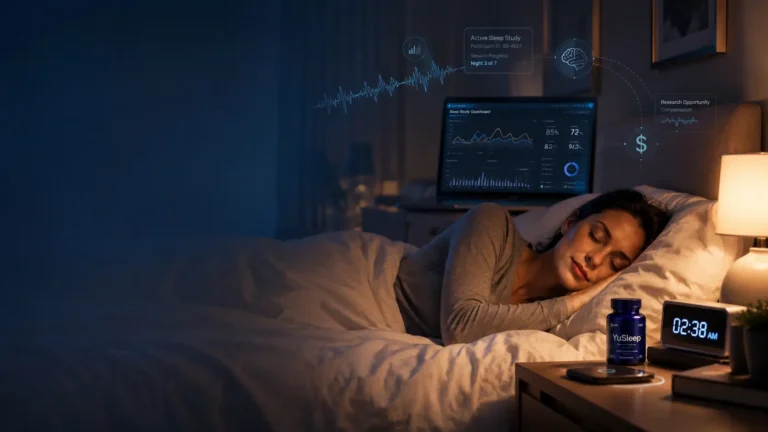
Can You Really Get Paid to Sleep?
Yes, legitimate paid sleep opportunities exist.
But they’re usually not conventional employment.
Stanford Medicine’s sleep research studies include opportunities with different eligibility requirements, time commitments, and compensation levels.
Depending on the study, you might be asked to:
- Sleep overnight in a research facility
- Follow a specific bedtime schedule
- Track your sleep at home
- Wear a sleep-monitoring device
- Complete questionnaires
- Participate in interviews
- Take part in daytime testing
- Follow restrictions involving caffeine, alcohol, exercise, or sleep timing
In return, eligible participants may receive compensation for their time and participation.
For example, University of Oregon’s sleep study involves home sleep tracking, laboratory visits, interviews and physiological assessments, with eligible participants able to receive compensation for their time.
Stanford Medicine also lists sleep research opportunities involving overnight sessions and other sleep-related activities, with compensation varying by study.
So the concept isn’t fake.
But don’t think of it as:
“Someone pays me because I’m good at sleeping.”
Think of it as:
“I’m being compensated for participating in legitimate research or testing where sleep is an important part of the process.”
That difference can save you from falling for misleading job advertisements.
1. Paid Sleep Research Studies
For most people searching for paid to sleep jobs, sleep research studies are probably the most legitimate place to start.
Researchers study sleep for many different reasons.
They may want to understand:
- How people move through different sleep stages
- How sleep affects memory
- How the brain behaves during sleep
- How sleep deprivation affects performance
- How circadian rhythms work
- Why some people have difficulty sleeping
- How different sleep interventions affect people
Participants may sleep in a controlled environment while researchers collect information about their sleep.
The experience can be interesting, but it isn’t necessarily as relaxing as sleeping in your own bedroom.
You may have monitoring equipment attached to you, scheduled sleep and wake times, questionnaires, or other study requirements.
The payment is therefore compensation for your time, participation, inconvenience, and sometimes travel, rather than simply payment for sleeping.
2. Paid Sleep Studies at Universities
Universities are one of the best places to look for legitimate sleep research.
Why?
Because academic institutions frequently conduct controlled studies involving human participants.
For example, Stanford Medicine publishes sleep research opportunities, while the University of Oregon has listed compensated sleep studies involving multiple forms of sleep tracking and assessment.
Other universities and medical research centers also recruit participants periodically.
How to find them
Try searches such as:
“paid sleep study near me”
“sleep research participants”
“paid sleep study + your city”
“sleep research volunteers + your state”
You can also check research pages from nearby universities, hospitals, and medical schools.
One important warning
Don’t assume a study is legitimate simply because the advertisement says you can earn a large amount of money.
Always verify:
- Who is conducting the study
- Where the study takes place
- What participation involves
- How compensation works
- Whether there are eligibility requirements
- What happens to your personal information
3. Remote Sleep Studies
Not every sleep study requires you to spend the night inside a laboratory.
Some research can be conducted partly or entirely from home.
For example, the UCSF SLEEPS Study allows eligible participants to complete study activities remotely and receive compensation for their time.
Depending on the study, remote participants may be asked to:
- Track their sleep
- Complete online surveys
- Record symptoms
- Attend video interviews
- Follow a sleep routine
- Use a wearable device
- Participate in an online sleep program
This can be attractive if you don’t want to travel to a research center.
However, remote doesn’t automatically mean easy.
A study may require daily participation for several weeks, so always calculate the time commitment, not just the advertised payment.
4. Overnight Sleep Research
Some studies specifically require participants to spend one or more nights in a sleep laboratory.
In these studies, researchers may monitor things such as:
- Brain activity
- Breathing
- Heart rate
- Movement
- Oxygen levels
- Sleep stages
- Circadian patterns
The National Institutes of Health has also conducted sleep research involving overnight participation and compensation for eligible volunteers.
These studies can be fascinating if you’re interested in science.
But they’re not necessarily a “free hotel night.”
You may have sensors, monitoring equipment, strict schedules, and specific instructions.
So if you see an advertisement saying:
“Earn $1,000 by sleeping overnight!”
don’t immediately assume you’re getting $1,000 simply for sleeping.
Read the study requirements.
5. Mattress Tester Jobs
Now we get to the opportunity that sounds most like the classic “get paid to sleep” job.
Mattress testing.
The concept is simple:
A company provides a mattress or sleep product, and testers evaluate things such as:
- Comfort
- Firmness
- Temperature
- Support
- Durability
- Overall sleep experience
You may then provide written feedback, ratings, questionnaires, photographs, or other information.
Sounds perfect, right?
Not necessarily.
The reality
Mattress testing isn’t usually a guaranteed full-time career.
Opportunities can be:
- Temporary
- Freelance
- Promotional
- Contract-based
- Product-specific
- Limited to certain locations
Sometimes the compensation may even be a free product rather than cash.
So treat mattress testing as an occasional opportunity, not a reliable replacement for a normal income source.
6. Sleep Product Testing
Mattresses aren’t the only sleep products companies may test.
Depending on the company and campaign, testers may evaluate:
- Pillows
- Bedding
- Sleep trackers
- Weighted blankets
- Eye masks
- Sleep apps
- White-noise devices
- Bedroom accessories
- Other sleep-related products
Again, compensation varies.
You might receive:
Cash → Gift card → Free product → Discount → Combination of benefits
Always check the exact terms before participating.
7. Overnight Jobs for Night Owls
There’s another category that gets mixed into “get paid to sleep” searches.
These are overnight jobs.
You aren’t actually being paid to sleep.
You’re being paid to work at night.
Examples may include:
- Night customer support
- Security roles
- Night auditing
- Overnight monitoring
- Warehouse positions
- Certain healthcare jobs
- Remote support
- Some hospitality positions
For people who naturally prefer staying up late, these schedules can sometimes feel more compatible than an early-morning job.
But there is a catch.
Working overnight doesn’t automatically mean you’ll sleep better.
In fact, working against your body’s preferred sleep timing can make maintaining a consistent sleep routine more challenging.
Why Your Work Schedule Can Affect Your Sleep
Your body has an internal timing system known as the circadian rhythm.
It helps coordinate your sleep-wake cycle and responds to environmental cues such as light and your daily routine.
That’s one reason some people naturally feel more alert at night while others prefer waking early.
Imagine two people.
Person A
Feels sleepy at 9:30 PM.
Naturally wakes around 5:30 AM.
An early shift may suit them.
Person B
Doesn’t feel naturally sleepy until around midnight.
Wakes comfortably around 8:00 AM.
A job requiring them to wake at 4:30 AM may feel much harder.
Neither person is necessarily lazy.
Their schedules simply don’t match equally well.
This is why searching for “jobs for night owls” can sometimes make more sense than searching for jobs that literally pay you to sleep.
But What If You’re Tired and Still Can’t Sleep?
This is where the conversation changes.
Maybe you aren’t actually looking for a sleep-related job.
Maybe you’re looking for a solution to a frustrating experience:
You’re exhausted—but your brain won’t switch off.
You get into bed.
You’re physically tired.
You close your eyes.
And suddenly your mind starts replaying everything that happened during the day.
Then you think about tomorrow.
Then you remember something you forgot.
Then you check the clock.
Then you realize you’ve been awake for another 40 minutes.
And now you’re frustrated because you’re thinking:
“I have to sleep. I have work tomorrow.”
That pressure can make winding down even harder.
Why Going to Bed Isn’t the Same as Winding Down
One of the biggest sleep mistakes is expecting the brain to switch from high stimulation to sleep mode instantly.
For example:
10:00 PM: Laptop
10:20 PM: Social media
10:40 PM: Work messages
11:00 PM: Finally get into bed
11:05 PM: “Why am I not asleep yet?”
Your body may be physically tired.
But your brain may still be processing information.
A better strategy is to create a transition.
Think:
Day → Wind down → Bed → Sleep
rather than:
Day → Bed → Sleep immediately
A simple wind-down routine might include:
- Dimmer lighting
- Less phone use
- No demanding work immediately before bed
- Relaxation exercises
- A consistent bedtime
- A comfortable bedroom
- Limiting caffeine later in the day
- A predictable nighttime routine
These habits aren’t exciting.
But they’re foundational.
Where Does YuSleep Fit?
If you’ve already improved your nighttime habits but still want additional sleep support, you may come across supplements such as YuSleep.
YuSleep is marketed as a multi-ingredient sleep-support supplement designed around relaxation and nighttime sleep support.
Current YuSleep promotional material lists ingredients such as red tart cherry extract, 5-HTP, vitamin B6/B2, magnesium glycinate and apigenin, while other YuSleep promotional pages also reference ingredients such as GABA, L-theanine and melatonin.
The important point is that YuSleep isn’t positioned simply as a single-ingredient sleep product.
Its broader approach is based around supporting several aspects of the nighttime routine.
For example:
GABA and L-Theanine
These ingredients are commonly associated with relaxation support.
That makes them particularly relevant to people whose biggest bedtime challenge is feeling mentally switched on.
Melatonin
Melatonin is involved in the body’s sleep-wake signaling process.
It isn’t the same thing as simply “knocking yourself out.”
Magnesium
Magnesium is an essential mineral involved in many processes throughout the body and is commonly included in nighttime wellness formulas.
Tart Cherry
YuSleep also highlights red tart cherry extract as part of its formula.
The key takeaway is simple:
YuSleep should be viewed as sleep support—not as a guaranteed cure for insomnia or other sleep disorders.
YuSleep Pros and Cons
Before buying any supplement, it’s worth looking at both sides.
YuSleep Pros
1. Multi-ingredient approach
YuSleep is marketed around a combination of ingredients rather than relying on one ingredient alone.
2. Focuses on nighttime support
Its positioning is centered around relaxation and sleep rather than daytime energy.
3. Fits naturally into a bedtime routine
A sleep-support product can be incorporated into a broader wind-down routine.
4. Convenient format
YuSleep is marketed in a liquid format, which some people may prefer over tablets or capsules.
5. Non-prescription supplement category
It’s positioned as a dietary supplement rather than a prescription medication.
YuSleep Cons
1. Results can vary
No supplement works identically for every person.
2. It isn’t a substitute for good sleep habits
Taking a supplement while staying on your phone until 2 AM isn’t a complete sleep strategy.
3. Underlying sleep problems need attention
Persistent insomnia, sleep apnea, severe daytime sleepiness, or other ongoing symptoms should not simply be treated as a supplement problem.
4. Ingredient details should be checked carefully
YuSleep promotional pages have presented somewhat different ingredient lists, so consumers should verify the current Supplement Facts label and serving information before purchasing.
5. Not appropriate for everyone
Anyone who is pregnant or nursing, has a medical condition, or takes medications should discuss new supplements with a qualified healthcare professional.
Who Might Consider YuSleep?
YuSleep may be worth researching if you’re an adult who:
- Has difficulty winding down before bed
- Wants additional nighttime sleep support
- Has an inconsistent evening routine
- Feels tired but mentally active at bedtime
- Wants a multi-ingredient sleep-support formula
But the important word is “consider.”
It doesn’t mean everyone needs it.
And if your sleep problems are persistent or severe, identifying the underlying cause should come before relying on any supplement.
What About the Money-Back Guarantee?
Current YuSleep promotional pages advertise a 60-day money-back guarantee, although exact offer terms can vary between sales pages, so it’s smart to confirm the terms on the checkout page you actually use before purchasing.
That’s useful because supplements aren’t one-size-fits-all.
But don’t interpret a guarantee as proof that a product will work.
A guarantee is a purchasing policy.
Evidence of effectiveness is a separate question.
That’s an important distinction when evaluating any health product online.
How to Avoid Fake “Get Paid to Sleep” Jobs
This deserves its own section because the phrase “get paid to sleep” is perfect bait for scams.
Be suspicious when a supposed opportunity:
Asks you to pay upfront
A legitimate employer or research organization shouldn’t require you to send money simply to “unlock” the opportunity.
Promises huge money for almost no work
“Earn $5,000 every month by sleeping at home” should immediately trigger skepticism.
Has no identifiable organization
If you can’t find a real company, university, hospital, or research organization behind the opportunity, walk away.
Wants excessive personal information immediately
Don’t provide sensitive information before you’ve verified who you’re dealing with.
Uses urgency
“Apply in the next 10 minutes or lose your spot!”
That’s a classic pressure tactic.
The best opportunities can be verified independently.
Pros and Cons of Getting Paid to Sleep
Before you start searching, here’s the realistic picture.
Pros
- You can participate in legitimate sleep research
- Some studies offer meaningful compensation
- You may contribute to scientific research
- Some opportunities can be completed remotely
- Sleep-product testing can provide useful experience
- Overnight work can suit some night owls
Cons
- Opportunities aren’t always available
- Eligibility can be strict
- Some studies require multiple visits
- Research environments may be uncomfortable
- Compensation varies
- Many opportunities are temporary
- Some online “sleep jobs” are misleading or fraudulent
So yes, getting paid to sleep is possible—but it isn’t as easy or common as social media makes it sound.
Frequently Asked Questions
Can you really get paid to sleep?
Yes. Legitimate sleep research studies and sleep-product testing opportunities can compensate participants. However, these are generally research or testing opportunities rather than conventional full-time jobs.
What jobs pay you to sleep?
The closest legitimate examples include paid sleep studies, overnight research participation, sleep-product testing and some mattress-testing opportunities.
How much can you earn from a sleep study?
It varies widely depending on the study, location, duration and requirements. Some university sleep studies advertise compensation ranging from relatively small amounts to hundreds or even around $1,000 for certain longer or more involved studies.
Are paid sleep studies legitimate?
Yes, many are legitimate. The safest place to start is with universities, hospitals, medical schools and recognized research organizations.
How do I find paid sleep studies?
Search university and hospital research pages, or use terms such as “paid sleep study near me” and “sleep research participants.” Always verify the organization before providing personal information.
Can I get paid to test mattresses?
Occasionally, yes. Mattress and sleep-product testing opportunities exist, but they aren’t necessarily stable full-time jobs. Compensation may be cash, products, gift cards, or another form of payment.
Are get-paid-to-sleep jobs scams?
Some are. Be particularly cautious when an opportunity asks for upfront payment, promises unrealistic income, has no verifiable organization, or pressures you to provide sensitive information.
What if I have trouble falling asleep?
Start by looking at your sleep routine, caffeine intake, evening stimulation, bedroom environment and consistency of your bedtime. If the problem continues or significantly affects your daytime life, consider discussing it with a healthcare professional.
What is YuSleep?
YuSleep is marketed as a dietary sleep-support supplement containing a combination of ingredients intended to support relaxation and nighttime sleep. Current promotional materials list ingredients including tart cherry, 5-HTP, B vitamins, magnesium and apigenin, with other promotional pages also referencing ingredients such as GABA, L-theanine and melatonin.
Is YuSleep a sleeping pill?
YuSleep is marketed as a dietary supplement, not a prescription sleeping medication. Its purpose is presented as nighttime sleep and relaxation support.
Does YuSleep contain melatonin?
Some current YuSleep promotional materials list melatonin among the ingredients, while other product pages present different ingredient lists. Because formulations can change, check the current Supplement Facts label on the product page before purchasing.
Is YuSleep right for everyone?
No. Individual responses to supplements vary. If you’re pregnant or nursing, take medication, have a medical condition, or have persistent sleep problems, speak with a qualified healthcare professional before using a new supplement.
Final Verdict: Can You Get Paid to Sleep?
Yes—but with a big asterisk.
You can potentially earn money through legitimate sleep studies, research participation, mattress or sleep-product testing, and certain overnight opportunities.
But you probably won’t find a normal career where your only responsibility is:
“Go to bed and wake up eight hours later.”
The better way to look at the opportunity is:
Sleep research + product testing + overnight work = legitimate possibilities.
At the same time, if you landed on this article because you’re already struggling with sleep, don’t overlook the bigger issue.
Maybe you don’t actually need a job that lets you sleep later.
Maybe you need to figure out why your body is tired but your brain doesn’t want to shut down.
Start with the fundamentals.
Create a consistent sleep schedule.
Give yourself time to wind down.
Reduce nighttime stimulation.
Make your bedroom comfortable.
Pay attention to caffeine and late-night habits.
And if you’re interested in additional sleep support, take a closer look at YuSleep’s current formula, ingredient label, usage directions, and offer terms before deciding whether it fits your needs.
**Better sleep isn’t about finding more hours to spend in bed.
It’s about making the hours you already have more restorative.**
And if a calmer, more consistent nighttime routine helps you wake up feeling better tomorrow, that’s arguably more valuable than getting paid to sleep today.
Health Disclaimer
The information provided on this website is for general educational and informational purposes only. It is not intended to diagnose, treat, cure, or prevent any disease, medical condition, or sleep disorder.
The content on this page should not be considered medical advice or a substitute for advice from a qualified healthcare professional. Individual results and experiences with dietary supplements can vary.
Before starting any new dietary supplement, including YuSleep, speak with your doctor, pharmacist, or another qualified healthcare professional—especially if you are pregnant or breastfeeding, have a medical condition, take prescription or over-the-counter medications, or have persistent or unexplained sleep problems.
If you regularly experience severe insomnia, excessive daytime sleepiness, loud snoring, breathing interruptions during sleep, or other concerning symptoms, consult a qualified healthcare professional rather than relying solely on a supplement.
Always read the product label, ingredient list, serving instructions, warnings, and current manufacturer information before using any dietary supplement.
Statements about dietary supplements have not necessarily been evaluated by the U.S. Food and Drug Administration (FDA), and this website does not claim that any product is FDA-approved unless explicitly supported by official regulatory documentation.
Affiliate Disclosure
Affiliate Disclosure: Some links on this website are affiliate links. This means that if you click a link and make a purchase, we may receive a commission from the seller or affiliate network at no additional cost to you.
Our affiliate relationship does not change the price you pay.
We only recommend products or services that we believe may be relevant and useful to our readers. However, you should always do your own research and review the product’s ingredients, terms, pricing, refund policy, and other information on the official sales page before making a purchase.
We are not the manufacturer of YuSleep and are not responsible for the product’s manufacturing, formulation, shipping, customer service, refunds, or individual results. For the most accurate and up-to-date product information, please refer to the official product website and current product label.
This disclosure is provided in accordance with applicable advertising and affiliate-marketing transparency requirements.
Important
Seeing a product mentioned on this website does not guarantee that it will work for you. No individual result is guaranteed, and testimonials or examples, where present, should not be interpreted as typical or guaranteed outcomes.
Our goal is to provide useful, transparent information so you can make your own informed decision.